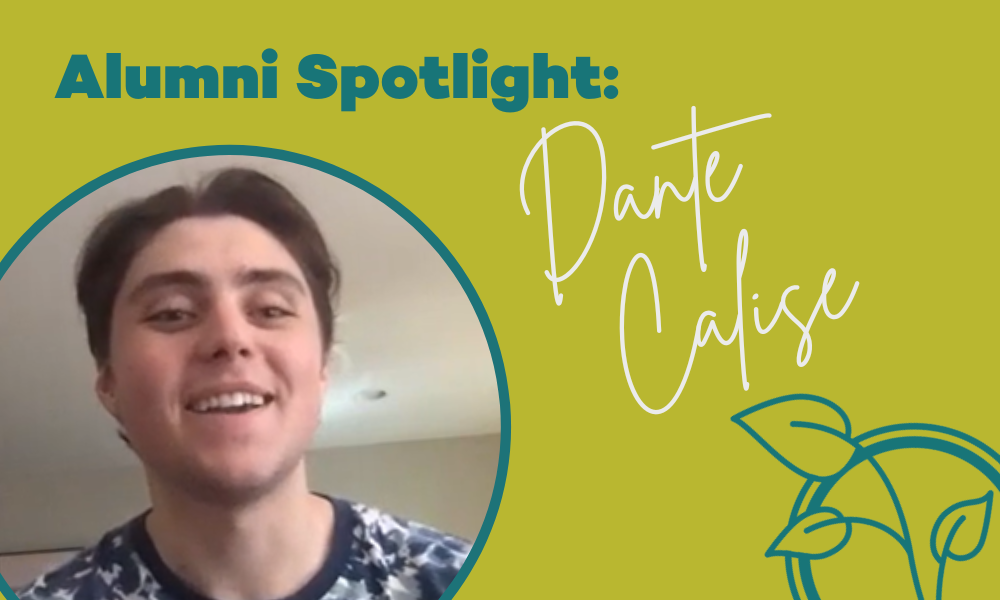
In the midst of the COVID-19 pandemic, our Head of School Paula Leigh-Doyle, met with former Hershey Montessori School student Dante Calise, via Zoom. Paula had several questions, many of them relevant to the times we’re living in.
Here is their interview conducted in May 2020.
[Paula] This is Dante Calise. Dante is interviewing with us from his home in Northbrook, Illinois. Dante, why don’t you tell us a little bit about your life journey? How old were you when you started Montessori?
[Dante] Sure! My parents like to say I was Montessori from the womb. Both of my parents are in Montessori education — they’re both trained in elementary and adolescent. My mom also worked as a toddler and primary teacher. I attended a primary Montessori school where I was taught by another family member, my aunt, at Countryside Day School. In 7th grade, I moved on to Hershey, and I was at the Hershey farm school (Huntsburg Campus) from 7th-9th grade, when at the time, Hershey did not have an upper school. I then went on to the Montessori high school at University Circle in Cleveland through 12th grade. I then ended up at the University of Delaware for my undergraduate, which I am now just finishing off. There, I studied molecular biology. I participated in a lot of research and am now headed off to the University of Wisconsin to start a PHD program in microbiology in August.
[Paula] Wow, that’s so exciting. So you’ve been accepted into that program?
[Dante] Yeah, I have.
[Paula] Congratulations, and so we have a few topics that we would like you to share some reflections on. When you reflect back on Montessori and your life experiences and environments, how do you think it has affected the path you’re choosing now, how it has contributed to your involvement with the community or the environment? How were you able to adapt to the academic expectations in college after being in Montessori schools? During this time of great challenge with COVID-19, and having to move onto your PHD program, what are some of the things that have helped you navigate challenge?
[Dante] I’ve been in Montessori all my life, up until college, which in a sense I feel like is quite similar to Montessori itself. I think that having had a Montessori education and background really created my excitement and interest for learning. That really is what has determined the trajectory of my academic career as well as I think my professional future. I’m going into research as I said, and really what drew me to research was just the fact that it’s kind of an opportunity to be a student for life. I’m always learning. Before the high school level there were no quantitative grades that I received and I always had control over what I wanted to learn and the paths that I wanted to follow.
[Paula] So as you mentioned that you didn’t have grades when in the younger years of Montessori, you were measuring your own work and choosing your own course of learning.
[Dante] Yes, so I think that the lack of quantitative and comparative evaluation against other students and my ability to choose what I was learning really let me get excited about the material and excited about the learning. I think if I had been receiving scaled feedback early on, it may have discouraged me from really committing to what was really important and that was the content. So I think that was a big part of how I grew to love to learn.
[Paula] When you got grades either in high school or in college, was that hard for you to move into that world?
[Dante] Interestingly, the first formal letter grades that I ever received were in 9th grade at Hershey and I actually was kind of excited. By that point I’d had enough time to learn to love school and really to fall in love with the classroom. I saw them as an opportunity to show my commitment to learning and into the material. It was exciting to see that someone acknowledged my commitment. I found that it was a pretty smooth transition.
[Paula] Did you have any real stretches academically in your undergrad?
[Dante] One of the biggest challenges for a lot of people in college is the shift from high school to college in terms of self-advocacy and the amount of self-advocacy that’s necessary. College almost always is larger than the high school you went to and there are thousands of students and many busy faculty members. You need to advocate for yourself a lot more than you might have in high school. I think people really do struggle with that in college. I think that having so much control and having to take initiative in my own education in the Montessori setting set me up very well to be able to succeed in college. I already knew how to reach out and advocate for myself quite well.
[Paula] Your relationship with your professors, how did you navigate that? It was easy for you to advocate for yourself?
[Dante] I didn’t have really have any trouble with my relationships or any interactions with professors. I generally had very good relationships with professors. Many professors I expect to remain in contact with after I graduate this month. I definitely think that is related to my education beforehand. At Hershey, there was always a very mutually respectful, and I would say mutually invested, relationship between teachers and students. I took that with me as I went on to college and not so much assumed but decided that’s how I wanted it to be in college as well. I would say that I never had any resistance from professors. I didn’t go to every professor’s office hours but when there was something that I wanted to talk about after classes, I would have thirty or forty minute conversations with them. I often got complements from professors about that, which showed that they really did appreciate it.
[Paula] Not every student in college has the confidence to initiate conversation with a teacher or someone that they think, thinks differently to them, and you seem to have ease with that. How about collaboration with peers, what was that like at college level?
[Dante] One aspect of college that is a challenge to many incoming students is moving away from home. One part of that is potential homesickness, and learning to live independently. Another part of this is also living in a physical space with other people. I already had that advantage from living at Hershey and the high school. I think especially having gone to boarding school, it prepared me well for any sort of work I would have to do with my peers in college. I would say I’ve really only had positive relationships with peers in the past four years, and I think a lot of that has to do with the skills I came in with.
[Paula] It sounds like you had the tools you needed to take on challenging problems, and they didn’t become big problems because you seemed to have the tools to manage them.
[Dante] Yes, whether I’d seen the problems before or just had the skills, I was basically able to overcome any hurdles I saw in college.
[Paula] So, a PHD in microbiology, tell us a little bit about that. You’re a passionate learner, you’re curious about everything in the world, from language to science. You’re narrowing down to this specific field, what’s calling to you about it?
[Dante] So a few things sort of guided me down this path into microbiology. I would say first was actually a class specific to viruses. My professor was a very engaging teacher and did a very good job of showing the relevance, and certainly that relevance is clear now we’re living in a situation where a virus is wreaking havoc on the world. The second component was the hardest part of finding out which area of biology I would like to pursue after my undergraduate. I fell in love with biology in ninth grade at Hershey. I can’t say I’ve ever heard another student describe a program that even compares to what I got to do. There was such a huge amount of hands-on learning in all the sciences at Hershey, for example, Occupations — that is very hands-on. To be able to go out into 90 acres of forest and document each class of vertebrate, to understand our own soil, to understand our own watershed. That really got me excited about biology. I like to look at things as a whole, so with humans or with animals in general, it’s very difficult to look at them on a whole organism level because they are just so complicated. With microorganisms, I found that I could look at the whole thing at once and I really like that about it.
[Paula] At that notion, of seeing the whole and that notion of the interaction and interdependence of an organism within an environment and how it works as a whole, seems to be a common thread in alumni that I’m hearing from. To say I don’t want to know just this one thing inside a box, I want to know all the parts and how they interact and relate to each other.
[Dante] Yes, and the idea of how one component fits into a bigger system has a lot to do with the importance of Montessori and the importance of a community that you leave Montessori with. I always think of my own impact on others and my own impact on the community, and that’s definitely true for biological things too.
[Paula] Yes, and my goodness, your contribution to community in your study, its going to contribute to humanity.
[Dante] That was part of the attraction of biomedical research for me. I’ve always known I’ve needed to do something that did something for someone. I think I’m young, but I do think about the impact that people leave after they’re gone on the world, and I really think it’s measured in the impact you’ve had on others. When I think about the science of it, that’s what it boils down to, is you leave some physical matter yes, but how you are remembered is what you are after you’re gone. I just think, well, what is the point, if not to help others have it better?
[Paula] Beautifully said, so you really have a wisdom beyond your years. If I come back and interview you when you’re 90, and I’m wondering… you probably will be saying the same thing. So studying science and studying things like a virus is going to be really meaningful and helpful for us as an entire civilization. Also just how we interact on our earth and how we are effecting all the aspects of the planet and how we can better live on it. During these challenging times, how have you been able to manage your stress?
[Dante] I will say, I do think Montessori has, for this COVID specific situation that we’re in right now, I think Montessori definitely equipped me, in very unique ways, that perhaps other people might not have. That’s really the sense of community membership and seeing yourself in the greater picture — and it matters. What I do really matters. Every little thing can impact someone else, and that’s absolutely true of the situation we’re in right now. I think those raised in Montessori have that advantage in the fact that they already recognize their impact on the world around them. So in a time where it really matters, they’re ready to do their best as citizens of the world.
[Paula] That’s beautiful, that gives me hope. I think you’re a bit of an optimist in a realist because you’re grounded in science and human history. You’ve studied how humans behave and respond, yet I hear an optimistic voice that you’re prepared to change path and the next challenge will give you more information and it’ll keep influencing where you go next. I think at the core, your self-awareness and your awareness of others is a beautiful, powerful thing and that’s influencing your choices and it benefits us all.