
Hershey News
Get an in-depth look at the rich learning experience of Hershey Montessori.
Hershey to Launch 4-Part Webinar Series on Adolescent Programs
Hershey Montessori is excited to announce its adolescent programs virtual event series. All are invited to join us on the second Thursday of each month from October through January 2027 for this four-part webinar journey exploring what is unique about Hershey Montessori School’s 7th-12th grade program at our Huntsburg Campus.
If you are a Montessori practitioner, new to Montessori, or considering Hershey for your teen, these virtual events will help you understand how our Montessori approach teaches and inspires students based on where they are in their developmental process. We will share how Hershey Montessori prepares students for graduation, for their chosen college and career path, and for meaningful lives.
Each session builds on one another, offering an inside look at how students grow in independence, purpose, leadership, and responsibility through authentic, relevant, experiential learning. Combined, these sessions will bring peace of mind to educators, parents, and caregivers as they learn how teens are set up for a successful launch into adulthood.
In these gatherings, we hope that you will also find a connection to a Montessori community devoted to elevating our understanding of the adolescent, and perhaps even your own teen.
All sessions begin at 7 p.m. and are scheduled to run just 30 minutes, plus time for Q&A immediately after. Tell your friends, and be sure to join us for one or all of these insightful conversations.
The series includes:
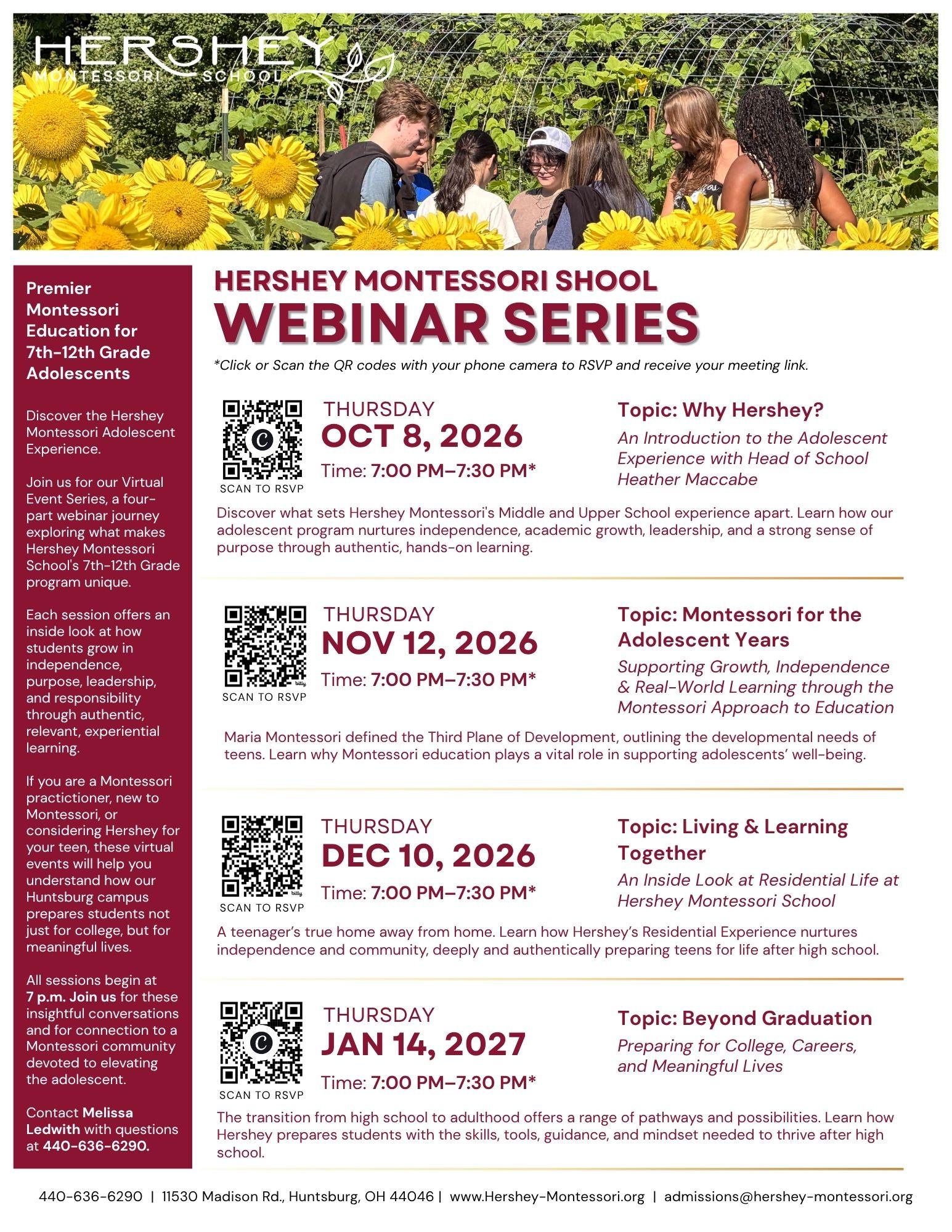 Thursday, October 8 @ 7 pm: Why Hershey? – An Introduction to the Adolescent Experience with Head of School Heather Maccabe
Join us to see how Dr. Montessori’s Erdkinder vision comes to life for students at Hershey Montessori School’s Huntsburg 7th-12th Grade Campus.
Thursday, November 12 @ 7 pm: Montessori for the Adolescent Years – Supporting Growth, Independence & Real-World Learning
Explore how Montessori education meets the unique developmental needs of adolescents. Learn why experiential learning, meaningful work, and community engagement foster confidence, responsibility, and lifelong curiosity.
Thursday, December 12 @ 7 pm: Living & Learning Together – An Inside Look at Residential Life at Hershey Montessori School
Discover how residential life extends learning beyond the classroom. Learn how students develop responsibility, collaboration, self-confidence, and lasting friendships through the unique boarding experience at Hershey.
Thursday, January 14 @ 7 pm: Beyond Graduation – Preparing for College, Careers, and Meaningful Lives
Learn how Hershey Montessori equips students to thrive after high school. Explore college preparation, career exploration, internships, leadership opportunities, and the real-world experiences that prepare students for life.
Download the series flyer to share and click on the title(s) below to sign up and receive your meeting link. We look forward to meeting with you!
- Thursday, October 8 – Why Hershey?
- Thursday, November 12 – Montessori for the Adolescent Years
- Thursday, December 12 – Living and Learning Together
- Thursday, January 14 – Beyond Graduation
If you have any questions, please contact Melissa Ledwith at 440-636-6290 or mledwith@hershey-montessori.org.

Hershey Welcomes Heather Maccabe as New Head of School
Hershey Montessori School is pleased to announce the appointment of Heather Maccabe as its new Head of School, ushering in an exciting new chapter for the internationally recognized Montessori institution. Heather officially assumed the role on July 1, 2026 in preparation for the 2026–27 academic year following an extensive global search led by the school’s Board of Directors.
A highly respected AMI Montessori educator and administrator, Heather brings more than three decades of experience in child-centered education and Montessori leadership. Her appointment follows a comprehensive 10-month search conducted by Carney, Sandoe & Associates that attracted distinguished candidates from around the world. The process included significant input from Hershey Montessori families, alumni, faculty, staff, and community members.
“Heather’s impressive credentials and experience in multicultural education make her ideally suited to be our next Head of School,” said Jeffrey Embleton, Board Secretary and chair of the search committee. “She is known for her passionate support of student and staff development and building strong school communities. We’re proud to gain her wisdom and expertise.”
Heather holds a Master’s Degree in Elementary Education with a Montessori concentration from the University of Hartford. She earned her AMI Primary Diploma from the Montessori Institute of Atlanta and her AMI Elementary Diploma from the Montessori Training Center of New England. She has also completed the AMI/NAMTA Orientation to Adolescence program in Chihuahua, Mexico, along with Montessori Whole School Leadership Training.
Throughout her career, Heather has served in leadership positions at several distinguished Montessori institutions, including Virgin Islands Montessori School and International Academy, The Montessori School in Wilton, Connecticut, and the Montessori Training Center Northeast in Hartford, Connecticut. Most recently, she served as Head of School at Arbor Montessori School in Decatur, Georgia.
For Heather, joining Hershey Montessori School is both a professional honor and a personal inspiration.
“Throughout my career, I have admired Hershey Montessori School for its dedication to Dr. Montessori’s vision for educating children and adolescents,” Heather said. “I am humbled to have been selected to serve as its Head of School.”
She emphasized the importance of balancing Montessori traditions with the evolving needs of students and communities.
“In a world that is constantly evolving, it is essential for school leaders to maintain a growth mindset: to be grounded in Montessori principles while also responsive to the changing needs of our communities,” Heather said. “I believe that by holding both the core values of an AMI Montessori education and a broad view of the world, we can create learning environments that are resilient, inclusive and profoundly impactful.”
Her appointment comes as Hershey Montessori School continues to build on its longstanding reputation as a leader in Montessori education. Board President John Cunningham expressed appreciation for the many community members who participated in the search process and helped shape the school’s future leadership.
“It was inspiring to have involvement from families, alumni, former and current members of staff and others with ties to Hershey going back decades, who care so deeply about their school,” Cunningham said. “We are grateful to the search committee as well as to Interim Head of School Diana Le Sieur, who led us through this transition with a steadfast commitment to Hershey Montessori School, its students, and staff.”
To ensure a smooth transition, Heather has spent the past several months meeting with faculty, staff, students, families, and board members, building relationships and gaining a deep understanding of the Hershey Montessori community before officially stepping into the role.
Founded more than 45 years ago, Hershey Montessori School serves students from birth through age 18 across its Concord and Huntsburg campuses. The school is recognized internationally for its commitment to authentic Montessori education and was among the first schools in the world to offer a complete Montessori curriculum from birth through graduation, including a boarding program on a working farm as part of its Middle and Upper School program.
As the 2026–27 school year approaches, the Hershey Montessori community looks forward to welcoming Heather’s leadership, vision, and deep commitment to Montessori education as the school continues its mission of nurturing capable, compassionate, and globally minded learners.

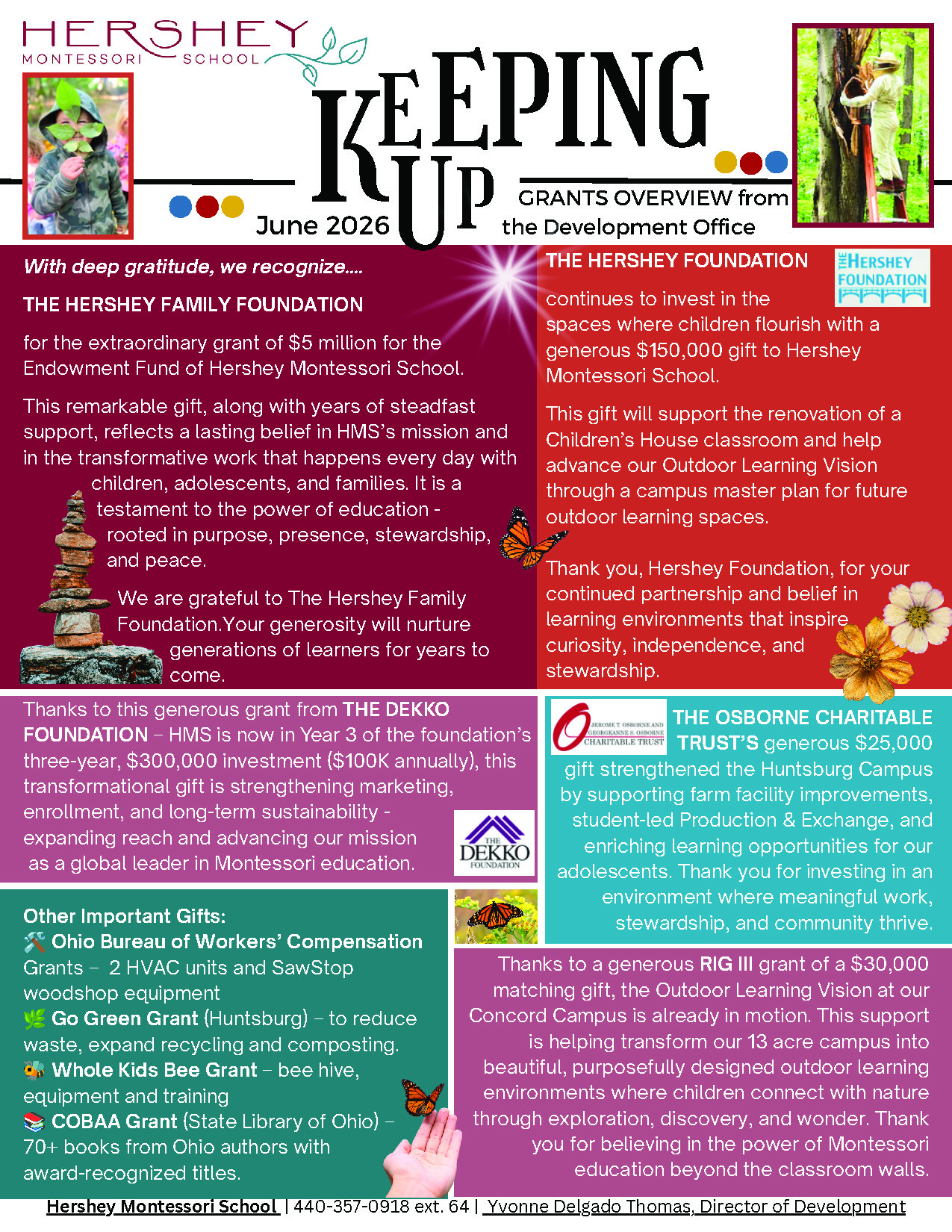
Keeping Up Newsletter – June 2026
Click the newsletter to view, download, and interact with our newsletter.

Hershey Montessori School Awarded Whole Kids Foundation Bee Grant

Huntsburg, OH — Hershey Montessori School is buzzing with excitement after being selected as a recipient of the Whole Kids Foundation Bee Grant, in partnership with The Bee Cause Project, bringing new hands-on pollinator education to its Middle and Upper School campus.
The Bee Grant Program empowers schools and nonprofits to create hands-on learning experiences through educational beehives, pollinator gardens, and curriculum that inspires curiosity and environmental stewardship.
With this support, Hershey Montessori School will install a Langstroth hive in late spring, led by Farm Manager and Mentor Melanie Blake and Ben Dallman, with assistance from staff and students. The project will actively engage students in establishing and maintaining a working hive while learning about the vital role bees play in our food system and environment.
“We’re thrilled to give our students the chance to connect with nature in such a meaningful way,” said Yvonne Delgado Thomas, Director of Development. “This grant will help them understand the interconnectedness of our entire ecosystem.”
The Bee Grant Program provides schools with resources to build educational beehives, pollinator habitats, and environmental curriculum. To date, it has awarded more than 1,100 grants, reaching over 1.4 million students nationwide.
For more information about the Bee Grant Program, visit wholekidsfoundation.org/bee-grant.

Hershey Montessori Adolescents Launch Summer Market Initiative, Partner with Local Food Program
Huntsburg, OH — Hershey Montessori School’s adolescent program is expanding its hands-on learning experience beyond the classroom this summer, bringing student-grown produce and community engagement to the Chardon Family Market.
In a collaborative effort between students and farm staff, the summer farm team will participate in the popular seasonal market, offering fresh vegetables, herbs, and other items cultivated by students throughout the growing season. The initiative represents both an educational milestone and a meaningful opportunity to connect with the broader community.
The project, which has been in development since mid-winter, is part of the school’s Montessori-based adolescent curriculum, emphasizing real-life responsibility, entrepreneurship, and community. While students have played an active role in preparing for the venture, staff members acknowledge that organizing a full market presence has required significant coordination.
“We’ve been working with students for months, but the full scope of what it takes to prepare for market season is complex”, said Hershey Farm Manager Joyce Cole. “A lot of the behind-the-scenes work is now coming together quickly.”
 Hershey families are being encouraged to visit the market and are being offered an additional opportunity to participate in Hershey’s Community Supported Agriculture (CSA) shares.
Through the CSA program, families will be able to purchase shares in advance, allowing them to select from student-grown produce and other farm products during Saturday market days and at a farm stand planned for Hershey Montessori School’s Huntsburg campus. Organizers hope the offering will provide families with flexible access to fresh, locally grown food while supporting the students’ work.
“This gives families a direct connection to what students are growing and producing,” Joyce explained. “It also helps students understand the full cycle of agriculture—from planting and harvesting to marketing and sales.”
Beyond the market initiative, the program is also deepening its commitment to community service. A portion of all produce grown this season will be donated to Claridon Community Helps, a local organization that provides meals for children during the summer months.
The partnership is already underway, with current harvests of lettuce and herbs being divided between market inventory and donations. At least half of this week’s yield, according to the farm team’s plan, will be directed to the organization.
Claridon Community Helps operates a network that prepares and distributes lunches across the area, ensuring children have access to nutritious meals when school is not in session. Hershey Montessori students will not only contribute produce but will also have the opportunity to volunteer in the organization’s kitchen, further strengthening the connection between agricultural work and community impact.
“This is a powerful extension of the Montessori philosophy,” said Deanna Shrum, Hershey Montessori School’s Communication Director. “Students see that their work feeds people—not just for sales at a market, but for service to community families who benefit from their support.”
The initiative reflects a broader vision of experiential education—one where academic concepts are integrated with meaningful, real-world applications. From managing crops to engaging with customers and supporting local food access, students are gaining insight into both business operations and social responsibility.
“We’re building something that will evolve over time,” Joyce said. “This summer is just the beginning.”
The Chardon Family Market is located in Chardon Square and runs June 6 and 20, July 11 and 18, August 1, 22, and 29 this summer season.
Families with children may participate in Hershey’s Farm Opportunity as well. Two dates are slated for those interested in enjoying a farm experience. See the flyer for details.
Interested families and CSA questions may be directed to Joyce Cole at jcole@hershey-montessori.org.

Hershey Welcomes International Educators for Montessori Adolescent Study Tour
Huntsburg, OH —Hershey Montessori School recently had the pleasure of welcoming an international group of Montessori educators to its Huntsburg Campus as part of a 25‑day global Montessori expedition highlighting innovative adolescent education.
The group tour, organized by Australian Roelie Hartwig of Montessori Tours and Travel, aimed to “share the successes and challenges of renowned Montessori Adolescent Programmes in the USA and Mexico.” The “unique tour was created for those working in, wanting to work in, wanting to improve, wanting to learn more about, Montessori Adolescent Programmes” as stated on the MT&T website.
 The visiting group included a dozen Montessorians representing New Zealand, the Czech Republic, Argentina, the Netherlands, and Australia. Traveling through the United States and Mexico on a curated study tour, the educators set out to see, learn, and experience Montessori education in action, with Hershey Montessori identified as a key destination along their journey. A featured itinerary map shared by the group traced their route across the United States and Mexico.
Members of the group referred to Hershey Montessori’s Huntsburg Campus as “the Mecca of Adolescent Education,” underscoring the school’s longstanding reputation as a global leader in Montessori practice for students ages 12–18. Their visit focused on observing adolescent classrooms and immersing themselves in Hershey Montessori’s distinctive approach to experiential, place‑based, and community‑focused learning.
During their time on campus, the educators observed students engaged in purposeful academic and real‑world work and remained through lunch to allow for dialogue with both faculty and students. These conversations offered valuable opportunities to exchange ideas about adolescent development, program design, and the practical application of Montessori philosophy in diverse cultural contexts.
Among the visiting educators was Mirka (Miroslava) Vlčková, an internationally engaged Montessori guide and education advocate with a strong global presence. She is the founder of Montessori Schools Andílek, a Czech Montessori program serving children from 15 months to 15 years, as well as the Montessori Institute Prague, an AMI training center. Through her work and social media outreach, Vlčková regularly shares Montessori practice and philosophy with an international audience, offering insight into innovative learning environments around the world.
As part of the visit, the group met with one of Hershey’s adolescent program founders, Laurie Ewert Krocker, who is an internationally recognized Montessori trainer and educational leader. Their time with Laurie provided a deeper forum for discussion about adolescent education, leadership, and the future of Montessori programs globally.
Hershey Montessori has long attracted educators from around the world who are eager to study its farm‑based adolescent programs and its emphasis on independence, responsibility, and meaningful work. This recent visit continues that tradition, reinforcing the school’s role as a hub for international collaboration, professional learning, and educational innovation.
The school community is grateful for these global connections and the shared commitment to advancing Montessori education worldwide.
For more information about Hershey Montessori School, call 440-357-0918 or email info@hershey-montessori.org.

Learning That Connects Generations
Wildwood Garden Club Visits Hershey Montessori School
On a misty March afternoon, Hershey Montessori Middle School students welcomed members of the Wildwood Garden Club of Mentor to their Huntsburg campus for a hands‑on, student‑led exploration of one of our most meaningful adolescent programs: maple syrup production. What unfolded was far more than a tour—it was a powerful example of intergenerational learning, authentic work, and Montessori education in action.
The visit began months earlier, when Emily Healy, a parent of a current Hershey Montessori student and a board member of the Wildwood Garden Club, reached out with an idea. Club members—many of whom are retired and longtime gardeners—were eager to visit a working maple syrup operation. Emily wondered if Hershey Montessori might be the right place for such an experience, especially one that could also benefit students.
That instinct proved exactly right.
Students as Teachers
Hershey Montessori adolescents in the Sugarbush Study and Work class stepped fully into leadership roles to prepare for the visit. Each student researched a specific part of the maple syrup process, becoming a “specialist” in everything from tree identification and tapping, to sap collection and evaporation, to product development and sales.
On the day of the tour, the adolescents guided their visitors through the entire process:
- How maple trees are selected and tapped
- How sap is collected and transported
- How it is boiled and transformed into syrup
- How finished products—such as maple syrup, maple candy, and maple sugar BBQ rub—are created and sold
Though the day was foggy and cool, the group adapted easily—moving between the sugarhouse and wooded areas, adjusting plans with flexibility and good humor.
What stood out most to visitors was that the experience was entirely student‑led.
“I guess some hadn’t heard that it was student led, and that was a pleasant surprise,” Emily later shared. “I received and overheard a lot of positive feedback. The students really impressed the group.”
Natalie Hudak, who oversees Hershey Montessori’s maple syrup programs and guided the students through the preparation process, reflected on the value of the experience: “I was so grateful that the students had an authentic presentation experience to prepare for. It is much different from just presenting to your peers.”
Preparing for a real audience beyond the classroom challenged students to deepen their understanding, collaborate with purpose, and communicate their knowledge with confidence. The experience mirrored the kind of meaningful, real‑world learning that Montessori adolescent programs are designed to provide.
Intergenerational Learning in Action
For Emily, the visit represented something even larger than maple syrup. As a board member focused on special projects, she is passionate about building bridges across generations through shared learning and care for the environment.
“So often, it is the differences between people on which we are encouraged to focus,” she reflected. “The difference between young people and seniors today is described as a ‘generational divide.’ It is important to me to help build bridges across the divides that create obstacles in understanding, respect, and growth.”
Watching adolescents confidently teach, explain, and engage with older adults revealed something powerful: qualities like curiosity, commitment, creativity, and care for the planet transcend age.
This is exactly what Montessori education aims to cultivate. When students take on real responsibility and meaningful work, they discover not only academic understanding, but also their own value and voice within a community.
Becoming Someone Who Knows What They Can Do
Experiences like this shape more than skills—they shape who students understand themselves to be. As adolescents prepared for and led the Wildwood Garden Club visit, they were not simply sharing knowledge; they were testing and confirming their identities as capable, thoughtful contributors.
Standing before adult visitors, students experienced a powerful shift. They saw themselves reflected not as learners completing an assignment, but as people whose understanding mattered. Answering questions, adapting explanations, and responding to the needs of their audience helped students internalize a new sense of confidence rooted in competence and trust.
Emily Healy noted that many visitors left surprised by what the students were able to do—but for the students themselves, the greater discovery was inward. Moments like these help adolescents recognize their own value, clarify their strengths, and understand that they have something meaningful to offer a community beyond their peers.
Experiences like this support a core developmental need of adolescence: forming a stable, confident sense of self. When students are entrusted with responsibility and supported through authentic experiences, confidence grows not through praise, but through lived understanding of their own capability.
Looking Ahead

A Tree Planted with Purpose
Celebrating Initiative, Learning, and Care at Concord
Each day at Hershey Montessori School, our children and adolescents show us what it looks like to take initiative, to care deeply, and to learn with purpose. There are countless moments like this across all levels—far more than we could ever fully capture. But every now and then, one unfolds in a way that invites pause and celebration.
Recently, that moment took root—quite literally—in Saren’s Early Elementary Community at our Concord campus.
Before Spring Break, a child shared a thoughtful idea: honoring Jane Goodall Day in celebration of Jane Goodall’s life and work. What began as a spark of curiosity quickly grew into a rich, child‑led project shaped by research, collaboration, and real‑world action.
The child, along with a friend, planned a first‑person research presentation as Jane Goodall, immersing themselves deeply in her story and contributions. But the learning didn’t stop there. Inspired by Jane Goodall’s commitment to conservation and care for living systems, the children decided to plant a tree on the playground in her honor.
What followed was a remarkable series of purposeful steps:
- Researching appropriate tree species
- Creating and conducting a class survey to choose the tree
- Meeting with our Head of School to determine a suitable planting location
- Making a phone call to a local nursery to purchase the tree
- Going on the trip to pick it up
- And finally, carefully planting it in the ground
Along the way, other children were inspired to join the project. New roles emerged naturally—David Greybeard, Jane Goodall’s close chimpanzee companion; Dr. Leakey, her first mentor; even the cameraman she would later marry. The project became a shared story, shaped by imagination, research, and collaboration.
On planting day, nearly the entire community gathered outdoors to help place a swamp white oak into the earth. The children affectionately named the tree “Sherman.” With hands in the soil and attention focused on the work before them, they experienced what Montessori education does best: learning made real, meaningful, and communal.
Moments like this remind us why Montessori education is so powerful. This was not an assignment handed down—it was an idea nurtured through curiosity, supported by adults, and carried forward by children who trusted their own capacity to act.
Whenever a tree is planted on our grounds with such intention and care, it is something for all of us to celebrate. We are grateful for the children who imagine what’s possible, the guides who make space for that vision, and the community that grows as a result.
Here is a glimpse of that day at Concord—roots laid down not only for a tree, but for a lifelong connection to learning, stewardship, and purpose.


Hershey Montessori Students Engage Community in Environmental Impact Book Study
Hershey Montessori adolescents explored hidden environmental impacts through research, life‑cycle analyses, and intergenerational book discussions inspired by Tatiana Schlossberg’s Inconspicuous Consumption.
 Physics, Energy, and the Environment
Understanding Hidden Environmental Costs
As part of their academic focus—Physics, Energy, and the Environment—Hershey students read Tatiana Schlossberg’s Inconspicuous Consumption: The Environmental Impact You Don’t Know You Have, a text that uncovers the unseen environmental impacts behind everyday items and routines.
The book examines four major sectors:
- Technology
- Food
- Fashion
- Fuel
Through seminar discussions, students explored striking examples—such as how streaming a movie in New York can burn coal in Virginia, or how affordable cashmere purchased in Chicago can contribute to desertification in Mongolia. These insights helped lay the groundwork for their own research.
Student‑Led Life Cycle Analysis Projects
Investigating Products from Extraction to End‑of‑Life
Building on the book’s framework, each student selected a commonly used item and researched its entire life cycle. Their investigations included:
- Raw material extraction
- Energy use and manufacturing processes
- Transportation and global supply chains
- Consumption patterns
- End‑of‑life disposal or recycling
By connecting their findings to broader global systems, students gained a deeper understanding of how everyday choices influence environmental outcomes. The insight they gained was transformative. With expanded awareness of the impact of daily decisions, the students felt both empowered and impassioned.
Public Presentations at Chardon Library and Lake Erie College
Empowering Adolescents as Community Educators
The students were then ready to bring their knowledge to others. This work culminated in two public events in late January held at the Chardon Library and Lake Erie College, where students presented their research and facilitated community book discussions. Community members were encouraged to attend with or without prior reading, and many joined out of interest in environmental issues and the opportunity to learn from student leaders.
Both forums were engaging and impactful. Students shared that personal engagement during these events was a highlight of the experience. One adolescent reflected:
“I felt I could tailor my information more towards who I was talking to at that moment and what they were interested in instead of having to make it really general for the whole group. I had many good and eye‑opening conversations with people who brought more info from different generations and perspectives.”
Attendees also expressed deep appreciation for the students’ leadership and engagement. One participant remarked:
“They all were very comfortable stating their opinions in the book discussion. They were attuned to the presentations and showed that they cared. They asked thoughtful questions that showcased their levels of interest. I think we all really enjoyed their insight and appreciated their interest.”
Another community member reflected on the value of participating in both events:
“Both discussions were very informative. I enjoyed hearing what other people had to say about the book. The wider age range (since I went to both the college and library) gave me a broad spectrum of knowledge.”
These reflections highlight the rich, intergenerational learning environment created by this work and the students’ leadership. Attendees described the conversations as eye‑opening, relevant, and highly engaging. The adolescents’ ability to guide discussions, explain complex concepts, and connect the book’s themes to real‑world challenges demonstrated maturity, confidence, and a strong command of the material.
Praise From Lake Erie College
Cari Ritzenthaler, Ph.D., Assistant Professor of Environmental Science at Lake Erie College, shared her enthusiasm:
“Their passion, curiosity, and thoughtful engagement were evident throughout both events. They did a fantastic job, and their posters were great. My college students really enjoyed the experience. Looking forward to collaborating again in the future!”
A Montessori Approach to Environmental Literacy
This project highlights Hershey Montessori School’s commitment to hands‑on, meaningful adolescent experiences that extend beyond the classroom. Through deep research, community participation, and leadership opportunities, students strengthened their:
- Critical thinking
- Environmental literacy
- Communication and facilitation skills
- Systems thinking
- Civic engagement
These experiences prepare adolescents to contribute thoughtfully and responsibly to their communities and the wider world.
Thank you to the staff and students and community for your work and contribution to this life-changing project.
Contact us if you are interested in learning more about Hershey Montessori’s Middle and Upper School programs.
Photos from the Inconspicuous Consumption Book Reading Events

Hershey Students Talk with College Students About Their Research Findings

Student Engages Attendee Over the Life Cycle of an Owala

Project: The Life Cycle of an Owala, by Petra

Student Shares Research on Environmental Impact of Vaseline

Student Discusses Inconspicuous Consumption book with community member

Student Shares Environmental Impact of Milk

Student Details Environmental Impact of #2 Pencils

Student Describes Environmental Impact of Beer

Hershey Student Reviews the Life Cycle of an iPad with College Students

Community discussion at Chardon Library

Student Shares Her Research with Community Members

Hershey and Lake Erie College Students Connect Over Research

Huntsburg Campus Fundraises for Geauga Hunger Task Force, Providing Over 1,000 Meals

Students and staff exceed fundraising goal to fight food insecurity in Geauga County through a creative November challenge.
A Creative Fundraising Challenge
 The fundraiser was part of a month-long campaign to raise awareness about hunger in the community. Some staff members added a fun twist by pledging not to shave during November and agreeing to a playful challenge. They agreed to subjecting themselves to a pie in the face if they lost a point contest. Points were earned through pennies and bills, while nickels, dimes, and quarters subtracted points—making the competition lively and engaging!

Impact Beyond the Classroom
“While a contest may name a winner, the real victory is found in supporting the dignity and well-being of those who will receive meals,” said Diana Le Sieur, Interim Head of School and Admissions Director.
Every dollar raised provides two meals to the more than 10,000 people in Geauga County who face food insecurity.
Last week, students and staff proudly handed a check for $608 to Sue Juhasz, Director of the Geauga Hunger Task Force. “This far exceeded our $300 goal,” said the Huntsburg team. “We are thrilled to make a difference and grateful to everyone who contributed.”