Learning That Connects Generations

Learning That Connects Generations

Wildwood Garden Club Visits Hershey Montessori School

On a misty March afternoon, Hershey Montessori Middle School students welcomed members of the Wildwood Garden Club of Mentor to their Huntsburg campus for a hands‑on, student‑led exploration of one of our most meaningful adolescent programs: maple syrup production. What unfolded was far more than a tour—it was a powerful example of intergenerational learning, authentic work, and Montessori education in action.

The visit began months earlier, when Emily Healy, a parent of a current Hershey Montessori student and a board member of the Wildwood Garden Club, reached out with an idea. Club members—many of whom are retired and longtime gardeners—were eager to visit a working maple syrup operation. Emily wondered if Hershey Montessori might be the right place for such an experience, especially one that could also benefit students.

That instinct proved exactly right.


Students as Teachers

Hershey Montessori adolescents in the Sugarbush Study and Work class stepped fully into leadership roles to prepare for the visit. Each student researched a specific part of the maple syrup process, becoming a “specialist” in everything from tree identification and tapping, to sap collection and evaporation, to product development and sales.

On the day of the tour, the adolescents guided their visitors through the entire process:

  • How maple trees are selected and tapped
  • How sap is collected and transported
  • How it is boiled and transformed into syrup
  • How finished products—such as maple syrup, maple candy, and maple sugar BBQ rub—are created and sold

Though the day was foggy and cool, the group adapted easily—moving between the sugarhouse and wooded areas, adjusting plans with flexibility and good humor.

What stood out most to visitors was that the experience was entirely student‑led.

“I guess some hadn’t heard that it was student led, and that was a pleasant surprise,” Emily later shared. “I received and overheard a lot of positive feedback. The students really impressed the group.”

Natalie Hudak, who oversees Hershey Montessori’s maple syrup programs and guided the students through the preparation process, reflected on the value of the experience: “I was so grateful that the students had an authentic presentation experience to prepare for. It is much different from just presenting to your peers.”

Preparing for a real audience beyond the classroom challenged students to deepen their understanding, collaborate with purpose, and communicate their knowledge with confidence. The experience mirrored the kind of meaningful, real‑world learning that Montessori adolescent programs are designed to provide.


Intergenerational Learning in Action

For Emily, the visit represented something even larger than maple syrup. As a board member focused on special projects, she is passionate about building bridges across generations through shared learning and care for the environment.

“So often, it is the differences between people on which we are encouraged to focus,” she reflected. “The difference between young people and seniors today is described as a ‘generational divide.’ It is important to me to help build bridges across the divides that create obstacles in understanding, respect, and growth.”

Watching adolescents confidently teach, explain, and engage with older adults revealed something powerful: qualities like curiosity, commitment, creativity, and care for the planet transcend age.

This is exactly what Montessori education aims to cultivate. When students take on real responsibility and meaningful work, they discover not only academic understanding, but also their own value and voice within a community.


Becoming Someone Who Knows What They Can Do

Experiences like this shape more than skills—they shape who students understand themselves to be. As adolescents prepared for and led the Wildwood Garden Club visit, they were not simply sharing knowledge; they were testing and confirming their identities as capable, thoughtful contributors.

Standing before adult visitors, students experienced a powerful shift. They saw themselves reflected not as learners completing an assignment, but as people whose understanding mattered. Answering questions, adapting explanations, and responding to the needs of their audience helped students internalize a new sense of confidence rooted in competence and trust.

Emily Healy noted that many visitors left surprised by what the students were able to do—but for the students themselves, the greater discovery was inward. Moments like these help adolescents recognize their own value, clarify their strengths, and understand that they have something meaningful to offer a community beyond their peers.

Experiences like this support a core developmental need of adolescence: forming a stable, confident sense of self. When students are entrusted with responsibility and supported through authentic experiences, confidence grows not through praise, but through lived understanding of their own capability.


Looking Ahead

We are grateful to our guests, Emily Healy, and the Wildwood Garden Club, for the opportunity to connect through our shared interests, learning rooted in curiosity, and mutual respect across generations.
 
For our students, this is Montessori education at its core. Experiences like this continue to shape how students see themselves, how capable they are, and how interconnected society is. This is how confidence is constructed and concepts are mastered — there is much learning in the doing — and like Montessori students, the members of Wildwood Garden Club modeled what it looks like to be lifelong learners.
 
We are grateful for partnerships that grow alongside our learners and look forward to more opportunities where learning, purpose, and community meet.


Grandparent or Special Friends Day 2026

Grandparent or Special Friends Day 2026

5/8/2026 — We are delighted to once again invite Grandparents or Special Friends to a special morning at the Concord Campus on Friday, May 8, 2028, for our annual Grandparents or Special Friends Day. This beloved Hershey tradition allows your child to share their work and classroom community with their grandparents or special friends.Just like last year,  we will be welcoming guests in staggered time slots by program level:

  • YCC  & Children’s House (morning only students) & their siblings
    8:45–9:30 AM
  • Children’s House (school day students) & their siblings
    10:00–10:45 AM
  • Elementary only
    11:15 AM–12:00 PM

For our families with siblings, we suggest visiting the youngest child first. Upon arrival, volunteers will help assist visitors to the appropriate classrooms where they’ll meet your child’s teacher and enjoy time seeing your child’s work and the environment.

Please note: Valet service will not be available this year. We kindly ask guests to arrive and depart within their designated time slot to help us manage parking and flow.

Kindly RSVP by Wednesday, April 22nd, 2026 using the survey link provided below. We kindly ask that families consider limiting the number of guests to no more than four grandparents or special friends.

**If your child will be leaving with you or their guest, please let me know via email the day of the event**

👉 Grandparents or Special Friends Day RSVP

Virtual Intro to Middle & High School and Boarding Life at Hershey

Virtual Intro to Middle & High School and Boarding Life at Hershey

4/28/2026 — Join us for a virtual introduction to Middle & High School and Boarding life at Hershey Montessori School.
Learn more about us and engage in first-hand dialogue with Hershey administrators, residential guide and former student.

Please RSVP to Stori Zinkhann at szinkhann@hershey-montessori.org or by calling/texting 440-935-4880.

Join us online on Tuesday, April 28th at 6:30 pm for a 35-minute discussion, including a time for Q&A.

Join us online at: https://meet.google.com/mxp-esrz-tdb

Hershey offers day student enrollment and partial and full-time boarding for students near and across the globe.

Hershey Montessori School’s vision is to see children and adolescents develop a strong sense of self, rooted in love for the environment and community, seamlessly transitioning from each stage of development through adulthood. We aim to ensure they are equipped to thrive in changing times and prepared to contribute to community as stewards of peace and humanity.

A Tree Planted with Purpose

A Tree Planted with Purpose

Celebrating Initiative, Learning, and Care at Concord


Each day at Hershey Montessori School, our children and adolescents show us what it looks like to take initiative, to care deeply, and to learn with purpose. There are countless moments like this across all levels—far more than we could ever fully capture. But every now and then, one unfolds in a way that invites pause and celebration.

Recently, that moment took root—quite literally—in Saren’s Early Elementary Community at our Concord campus.

Before Spring Break, a child shared a thoughtful idea: honoring Jane Goodall Day in celebration of Jane Goodall’s life and work. What began as a spark of curiosity quickly grew into a rich, child‑led project shaped by research, collaboration, and real‑world action.

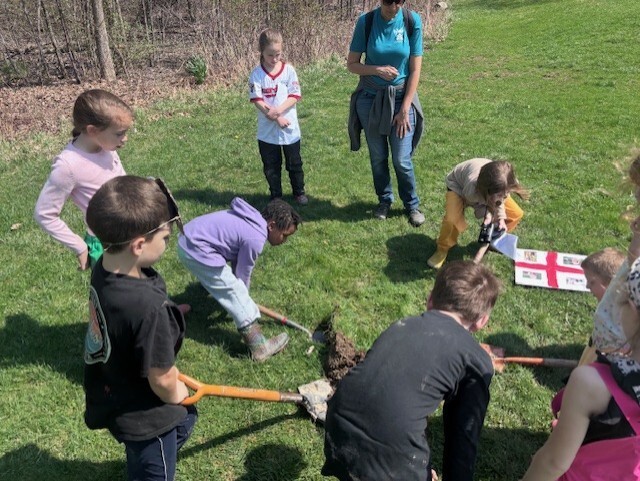
The child, along with a friend, planned a first‑person research presentation as Jane Goodall, immersing themselves deeply in her story and contributions. But the learning didn’t stop there. Inspired by Jane Goodall’s commitment to conservation and care for living systems, the children decided to plant a tree on the playground in her honor.

What followed was a remarkable series of purposeful steps:

  • Researching appropriate tree species
  • Creating and conducting a class survey to choose the tree
  • Meeting with our Head of School to determine a suitable planting location
  • Making a phone call to a local nursery to purchase the tree
  • Going on the trip to pick it up
  • And finally, carefully planting it in the ground

Along the way, other children were inspired to join the project. New roles emerged naturally—David Greybeard, Jane Goodall’s close chimpanzee companion; Dr. Leakey, her first mentor; even the cameraman she would later marry. The project became a shared story, shaped by imagination, research, and collaboration.

On planting day, nearly the entire community gathered outdoors to help place a swamp white oak into the earth. The children affectionately named the tree “Sherman.” With hands in the soil and attention focused on the work before them, they experienced what Montessori education does best: learning made real, meaningful, and communal.

Moments like this remind us why Montessori education is so powerful. This was not an assignment handed down—it was an idea nurtured through curiosity, supported by adults, and carried forward by children who trusted their own capacity to act.

Whenever a tree is planted on our grounds with such intention and care, it is something for all of us to celebrate. We are grateful for the children who imagine what’s possible, the guides who make space for that vision, and the community that grows as a result.

Here is a glimpse of that day at Concord—roots laid down not only for a tree, but for a lifelong connection to learning, stewardship, and purpose.

The Purpose of the Farm in Montessori Education

The Purpose of the Farm in Montessori Education

Why a Farm?


The Erdkinder Vision: Belonging, Purpose, and Real‑World Learning

The Hershey Montessori School Huntsburg Campus farm is far more than a location—it is an essential part of our prepared environment for adolescents. Dr. Maria Montessori envisioned a farm‑based learning community, the Erdkinder (“children of the earth”), as the ideal setting for young people ages 12–18. She recognized that during this developmental stage (the Third Plane), adolescents are seeking belonging, purpose, independence, and authentic contribution. A farm offers exactly that in a living, breathing ecosystem of meaningful work, community responsibility, and real‑world learning.


Integrating Manual and Intellectual Work Through Farm Life

Dr. Montessori observed that adolescents need a balance of “manual and intellectual work” to feel whole and capable, noting that these two forms of work “complete each other and are equally essential to a civilized existence”. On the farm, academic studies intertwine naturally with daily responsibilities. Mathematics emerges in budgeting and construction projects; biology becomes vivid through animal husbandry and crop cycles; history and economics come alive as students participate in small‑scale production and exchange, contributing to a functioning micro‑economy, as seen in other adolescent Montessori programs.


Moral Development and Community Responsibility in Action

The purpose, however, reaches far beyond academics. Montessori emphasized that adolescents need to “understand society and find their place in it,” and she believed a working farm allows them to do this through genuine contribution and community living. At Hershey, students learn not only how to care for the land but how to care for one another. They practice collaboration, conflict resolution, and shared responsibility as they meet the needs of their community. This is why so many Montessori organizations describe the farm as “the ideal prepared environment for the adolescent,” supporting moral development, stewardship of the earth, and a deepened sense of responsibility to both self and society.


Leadership, Apprenticeship, and the Practice of a Micro‑Society

In addition, the farm provides developmental opportunities for students to step into real managerial and apprentice roles that mirror the functioning of a small society. As managers, students guide peers, organize workflow, communicate updates and expectations, and lead collaborative decision-making that affects daily operations of the farm and its micro‑economy. Apprentices work alongside them to learn skills, build confidence, and contribute meaningfully to the community. These rotating roles give adolescents firsthand experience with leadership, collaboration, problem‑solving, and accountability—skills Montessori identified as essential for understanding how society is organized and for developing independence during this developmental stage, preparing them for life after high school. Through this structure, students discover their strengths, gain trust in their abilities, and learn how to contribute responsibly to a community, all within a supportive, real‑world environment.


Emotional Well‑Being Through Grounded, Meaningful Work

The farm also nurtures emotional well‑being. Research from Montessori adolescent programs highlights the farm as a setting that promotes independence, resilience, and confidence through real work with real consequences—qualities that adolescents desperately need as they transition toward adulthood. The land offers grounding, purpose, and a connection to nature that is both educational and restorative.


Preparing Capable, Compassionate, and Confident Adults

For us at Hershey Montessori School, the farm is not about preparing young people to become farmers—it is about preparing them to become capable, compassionate, and confident adults. It is a place where learning is lived, where community is practiced, and where adolescents discover the power of meaningful work. It honors who they are becoming and gives them an environment worthy of their potential.

This is the heart of Montessori adolescent education—and it is the reason the farm remains central to our mission. It is the reason our graduates are grounded, emotionally balanced, well-equipped, and capable of achieving great things.


Scroll the photo gallery below to see more examples of what takes place on the farm. We welcome you to contact us to learn more at admissions@hershey-montessori.org or call 440-636-6290.

2026 Hershey Wonder Gala

2026 Hershey Wonder Gala

4/10/2026 — A Night of Creativity, Curiosity & Connection

— Benefiting Hershey Montessori School & Montessori Education

Step into a world where imagination knows no limits and the spirit of discovery lives in every moment. 
WONDER is more than a gala — it’s a celebration of what makes Montessori education extraordinary.

Join us for an unforgettable evening filled with wonderful experiences, meaningful conversation, and wondrous surprises, all in support of a world-renowned Montessori school that has been nurturing the next generation of thinkers, creators, and compassionate leaders.

At this magical gathering, your presence will help:

  • Spark creativity in young minds through hands-on learning.
  • Cultivate curiosity that lasts a lifetime.
  • Strengthen the connection between education and community.

Whether you’re a longtime supporter or newly discovering the magic of Montessori, this is your moment to make a lasting impact. Let’s come together to celebrate the power of education and the boundless wonder it inspires.

Date: Friday, April 10, 2026

Doors Open: 6:00 pm

Location: Tall Oaks Resort and Event Center

9199 Chillicothe Rd, Kirtland, OH 44094

Sponsorship, advertising, and auction donation opportunities are available!

Join the Hershey community for this incredible night!


Please contact Yvonne Delgado Thomas with any questions at ythomas@hershey-montessori.org.

The Future is Now. Explore it With Us.

Register for an Open House or

Join us for our Adolescent Webinar Series

Reserve My Space