Oct 30, 2019 | Life at Hershey |
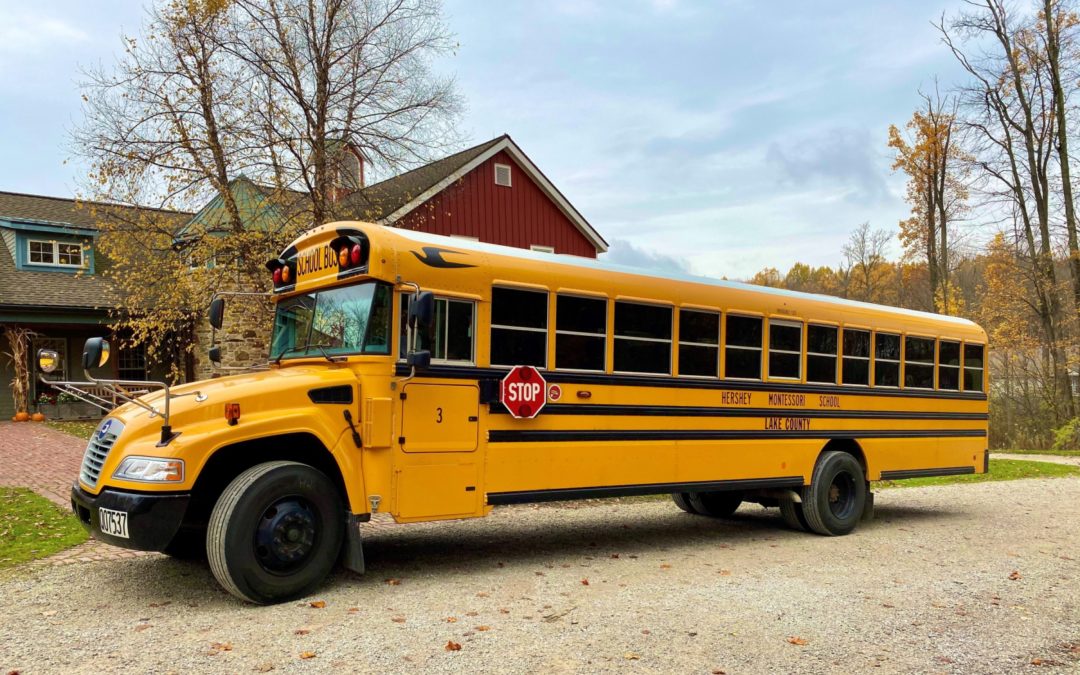
It’s True. We Provide School Bus Transportation!
It may have been our best kept secret, though it was never intended to be. Hershey Montessori School offers school busing services for our Middle and Upper School students attending our Huntsburg Campus.
Options include one-way or round trips for our Day and Interim Boarding Students.
Pricing ranges from $780 to $3,900 per year, depending on the service option selected.
We are listening to the needs of our parent community and continually evaluating the need for additional stops to accommodate the busing needs of our students.
We also provide inter-campus shuttle service from Hershey’s Concord Campus to Hershey’s Huntsburg Campus five days a week free of charge.
Learn more here or contact us at 440-357-0918 with your questions.
Oct 15, 2019 | Life at Hershey, School Blog |
A Close Look at Immigration
Immigration has been a central focus of media outlets everywhere. Reporters, commentators, and the general public are expressing views and interpretation of law. Hershey Montessori Guide, John Buzzard, saw the opportunity in seeking greater understanding for his students as they are preparing to enter and contribute to society as young adults.
When law meets humanity
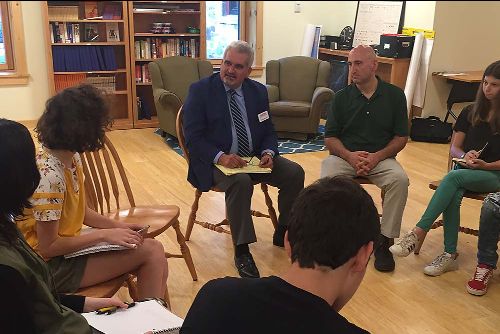
John began by extending an invitation to George Koussa to visit Hershey students at the Adolescent Campus in Huntsburg, Ohio. Mr. Koussa, who is a Syrian immigrant, accepted and openly shared his experience as an immigrant, along with his thoughts around current immigration policies in the United States.
John additionally spoke with Hershey Montessori students about their perspectives and thoughts on having Immigration and Customs Enforcement (ICE) come to speak to them as a group. The students were supportive of the idea, knowing that hearing from different perspectives is beneficial, and that this particular perspective is extremely important given it is representative of the U.S. Government.
John and his students extended an invitation, which then led to an informative visit from Valentina Seeley and Kris Crowley from ICE. In spite of the many controversies currently surrounding ICE, Mr. Seeley and Mr. Crowley were gracious and kind as they presented a wealth of information and documents to help inform and illustrate the challenges and protocols of immigration. The students respectfully asked challenging questions of Mr. Seeley and Mr. Crowley. Hershey Montessori School has nearly two dozen boarding students from countries outside the United States. Students saw value in the opportunity to meet with ICE, and several committed to continue their own research on some of the more controversial topics.
Both guests expressed how impressive Hershey students were and how much they appreciated having a reasoned conversation around their work, which is not always the case in their professional work.
A short time later, Hershey students embarked on a trip to Downtown Cleveland to observe a Naturalization Ceremony. It was an invaluable experience that put faces to names and envisioned real lives over simple stories. It allowed students to experience the immigration process as both a logistical matter and a personal one.
Hearing about life-changing issues is important, but immersing ourselves in the process allows for greater comprehension. As adolescents take their place in the next generation of influencers and decision makers, they must be properly prepared and ready to tackle global concerns like these.

Feb 16, 2018 | Alumni Spotlight, Featured Posts, Hershey Alumni, Life at Hershey |
Marianna Pasaret is a 2012 graduate of the Huntsburg campus of Hershey Montessori School. She is a current resident of Austin Texas and was recently interviewed by ESPEROS in their SoHo stories blog which focused on Lifting Women Up.
Read it here!
Marianna is a multimedia artist, concentrating on a combination of digital and sketch work. She exhibited in London late last year and was Boss Babes’ resident artist last winter. Read her inspiring interview where she discusses what and who empowers her and how she lifts other women up. We at Hershey are very happy for her success both as an artist and an inspiration!

Apr 6, 2017 | Capital Campaign |
You’ve been hearing about the Passive House approach to the new Upper School building on the Huntsburg Campus. In fact, Hershey Montessori School’s Upper School will be the first school in the Midwest designed with Passive House Institute United States (PHIUS) criteria. Here’s a little information to clarify all the hype about this environmentally friendly and energy saving technology.
What is Passive House?
Simply put, “Passive house (German: Passivhaus) is a rigorous, voluntary standard for energy efficiency in a building, reducing its ecological footprint. It results in ultra-low energy buildings that require little energy for space heating or cooling.” (ref Zeller, Jr., Tom. Beyond Fossil Fuels: Can We Build in a Brighter Shade of Green?, New York Times, September 26, 2010, p.BU1)
Passive Building Principles
Passive building comprises a set of design principles used to attain a quantifiable and rigorous level of energy efficiency within a specific quantifiable comfort level. “Maximize your gains, minimize your losses” summarize the approach. To that end, a passive building is designed and built in accordance with these five building-science principles:
- It employs continuous insulation through its entire envelope without any thermal bridging.
- The building envelope is extremely airtight, preventing infiltration of outside air and loss of conditioned air.
- It employs high-performance windows (typically triple-pane) and doors.
- It uses some form of balanced heat- and moisture-recovery ventilation and uses a minimal space conditioning system.
- Solar gain is managed to exploit the sun’s energy for heating purposes and to minimize it in cooling seasons.

Image credit: By Passivhaus_section_en.jpg: Passivhaus Institutderivative work: Michka B (talk) – Passivhaus_section_en.jpg, CC BY-SA 3.0, https://commons.wikimedia.org/w/index.php?curid=9586761
The Development of Passive House Principles
Passive principles were pioneered in the 1970s by North American building scientists and builders with funding from the U.S. Department of Energy and the Canadian government. In the late 1980s the German Passivhaus Institut (PHI) built on that research and those principles, and developed a quantifiable performance standard that continues to work well in the Central European and similar climate zones. The PHIUS website offers an excellent history lesson here.
Passive House Applications
Passive building principles can be applied to all building typologies–from single-family homes to apartment building to offices and skyscrapers.
Passive design strategy carefully models and balances a comprehensive set of factors including heat emissions from appliances and occupants–to keep the building at comfortable and consistent indoor temperatures throughout the heating and cooling seasons. As a result, passive buildings offer tremendous long -term benefits in addition to energy efficiency:
- Superinsulation and airtight construction provides unmatched comfort and even in extreme conditions.
- Continuous mechanical ventilation of fresh filtered air assures superb air quality.
- A comprehensive systems approach to modeling, design and construction produces extremely resilient buildings.
- Passive building is the best path to Net Zero and Net Positive buildings. because it minimizes the load that renewables are required to provide.
The Performance Standard
In practice, the PHIUS Technical Committee and PHAUS members building projects have learned that a single standard for all North American climate zones is unworkable. In some climates, meeting the standard is cost prohibitive, in other milder zones it’s possible to hit the European standard while leaving substantial cost-effective energy savings unrealized.
Consequently, the PHIUS Technical Committee worked on adapting the performance metric to North American climate zones, using the European metric as a baseline. An overview of those climate zone specific standards is available here.
Why did we do it?
Hershey Montessori School is committed to care of the environment, and thus committed to implementing as environmentally friendly and sustainable construction principles as possible. We are proud to be the first school in the Midwest to be designed with the cutting-edge standards of the Passive House Institute of the United States. PHIUS building criteria will create significant savings in operation costs and reduce energy consumption and provide an excellent model for other public buildings.
For more information on Passive House design, visit the Passive House Institute United States website.

